Hardware Ownership Wins: Why UK Gamers Are Walking Away From Cloud Subscriptions in 2025
When cloud gaming platforms launched in earnest across the United Kingdom, the proposition was compelling: stream console-quality games to any device, eliminate expensive hardware purchases, and pay a manageable monthly fee. For a brief period, it appeared that the traditional gaming PC might become a relic. In 2025, however, the data tells a rather different story. British gamers are cancelling subscriptions, selling streaming sticks, and investing in physical hardware at a rate that has surprised even industry observers.
Understanding why requires examining not just the technology, but the lived experience of gaming across the UK's highly variable broadband landscape.
The Promise Versus the Reality of Cloud Gaming in Britain
Cloud gaming's fundamental weakness in the United Kingdom is structural rather than technological. The service depends entirely on low-latency, high-bandwidth, consistent internet connectivity — a resource distributed deeply unevenly across British postcodes. While urban centres such as London, Manchester, and Birmingham benefit from full-fibre infrastructure capable of sustaining sub-20ms connections to gaming servers, vast swathes of rural England, Wales, Scotland, and Northern Ireland remain dependent on ageing ADSL or patchy 4G connections.
Ofcom's 2024 connectivity data confirms that approximately 17% of UK premises still cannot access gigabit-capable broadband. For those households, cloud gaming is not merely suboptimal — it is functionally unusable for competitive or fast-paced titles. Even in well-served urban areas, shared network congestion during peak evening hours introduces latency spikes that render precision gaming unreliable.
The consequences are measurable. Input lag on cloud platforms, even under favourable conditions, typically ranges between 40ms and 80ms. By contrast, a mid-range local gaming PC delivers input-to-display latency below 10ms. In genres where milliseconds determine outcomes — first-person shooters, fighting games, rhythm titles — this gap is not a minor inconvenience. It is a competitive handicap.
The Economics of Subscription Dependency
Beyond performance, the financial case for cloud gaming has deteriorated considerably over the past two years. Multiple platforms have raised their UK pricing, with premium tier subscriptions now commanding between £14.99 and £19.99 per month. At the upper end, that represents an annual expenditure of approximately £240 — and that figure purchases nothing tangible.
Consider the alternative. A competent mid-range gaming PC, built from quality components, can be assembled in the United Kingdom for between £700 and £900 at current market prices. Such a system — equipped with a capable discrete GPU, 16GB of DDR5 memory, and a fast NVMe solid-state drive — will comfortably handle the majority of current titles at 1080p or 1440p with high settings. Critically, that hardware belongs to the buyer outright.
Applying straightforward arithmetic: at £240 annually, a cloud gaming subscription recoups the equivalent of a £900 PC build in under four years. However, a well-maintained gaming PC retains meaningful resale value and can be incrementally upgraded, whereas subscription payments accumulate without residual worth. Over five years, the owned-hardware model typically delivers substantially greater value.
Furthermore, game purchases on PC platforms — through Steam, GOG, and similar storefronts — accumulate in a permanent personal library. Cloud gaming subscribers are increasingly discovering that titles can be removed from platform libraries with minimal notice, effectively erasing access to games they believed they had paid to play.
Disappearing Libraries and the Trust Deficit
The library removal issue has proven particularly damaging to cloud gaming's reputation among British consumers. Several high-profile titles have been withdrawn from major subscription catalogues in 2024 and 2025, prompting widespread frustration. Consumer rights organisation Which? noted a marked increase in complaints related to digital service content removals, reflecting a broader unease about the impermanence of subscription-based access.
This has crystallised a philosophical shift among a significant cohort of British gamers: the distinction between access and ownership matters. Purchasing a physical game — or a DRM-free digital copy — provides a degree of permanence that monthly access fees fundamentally cannot replicate. The resurgence of interest in physical media, combined with growing enthusiasm for platforms offering DRM-free downloads, reflects this reassessment.
What a Sensible UK Gaming PC Build Looks Like in 2025
For British gamers weighing the transition away from cloud services, the component market in 2025 is genuinely favourable. GPU availability has normalised, pricing has moderated from the peaks of previous years, and the second-generation AM5 and Intel Core Ultra platforms offer excellent mid-range value.
A pragmatic build targeting 1080p to 1440p gaming at high settings might comprise:
- Processor: A mid-range AM5 or Intel Core i5 variant offering strong single-threaded performance
- Graphics card: A current-generation mid-tier discrete GPU from AMD or NVIDIA
- Memory: 16GB DDR5 in dual-channel configuration
- Storage: A 1TB NVMe PCIe 4.0 solid-state drive for the operating system and primary game library
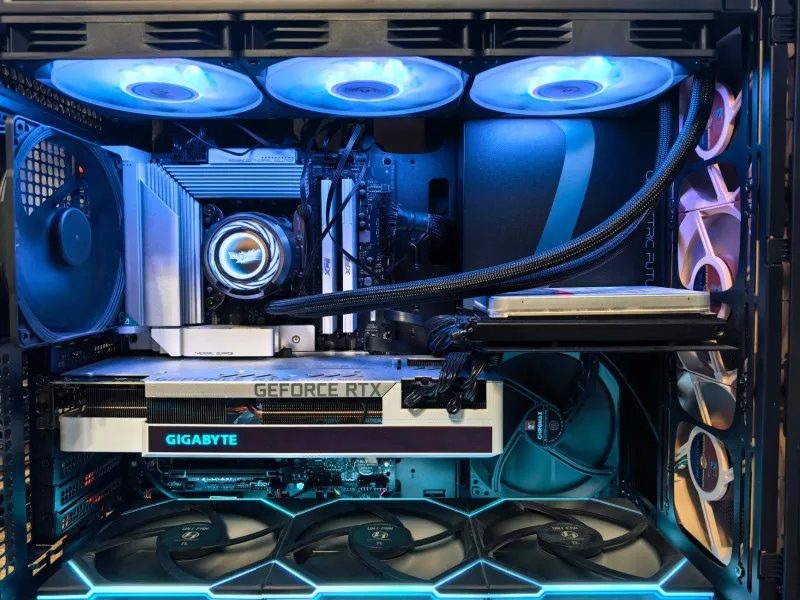
- Cooling: A quality 120mm or 240mm all-in-one liquid cooler or premium air cooler
- Power supply: An 80 Plus Gold-rated unit of appropriate wattage with a reputable manufacturer behind it
- Case: A mid-tower with adequate airflow and cable management provisions
Sourcing components through a trusted UK distributor ensures warranty coverage under British consumer law, avoiding the complications that can arise with grey-market imports. VAT-inclusive pricing also provides transparency that overseas storefronts sometimes obscure.
Regional Considerations for British Buyers
For gamers in regions where broadband infrastructure remains limited, the case for owned hardware is unambiguous. Even where full-fibre connectivity is available, the economics of ownership outperform subscription dependency over any horizon beyond three years.
Urban gamers with excellent connectivity might legitimately use cloud platforms as a supplementary service — accessing a handful of titles without committing to a full purchase — but treating cloud gaming as a primary platform carries meaningful risk, both in terms of performance reliability and long-term cost.
Conclusion
The cloud gaming experiment has delivered valuable lessons for the British gaming community. Streaming technology has genuine merit as a supplementary tool, but the infrastructure realities of the United Kingdom, combined with escalating subscription costs and the impermanence of licensed access, have exposed the limitations of dependency on remote hardware. Owned computing equipment, sourced thoughtfully and maintained properly, continues to represent the most reliable, cost-effective, and genuinely satisfying foundation for gaming in Britain. The market is responding accordingly.