Full Fibre, Half Performance: The Internal Hardware Bottlenecks Undermining Britain's Broadband Upgrade

Photo: HOT, CC BY-SA 4.0, via Wikimedia Commons
Full Fibre, Half Performance: The Internal Hardware Bottlenecks Undermining Britain's Broadband Upgrade
The UK government's commitment to rolling out gigabit-capable full-fibre broadband across Britain represents one of the most significant infrastructure investments of the current decade. Openreach, Virgin Media O2, and a growing number of alternative network providers have collectively passed millions of premises with fibre-to-the-premises (FTTP) connections capable of delivering 1Gbps or greater. For households and businesses that have upgraded their service, the expectation of transformative speed is entirely reasonable.
The reality, for a great many of those users, is considerably more modest. Bandwidth tests conducted from a laptop connected via Wi-Fi frequently return results that bear little resemblance to the headline speeds on the broadband contract. Desktop computers hardwired to the router via a decade-old cable may perform better, but still fall short of what the connection should theoretically deliver. The culprit, in the majority of these cases, is not the external infrastructure — it is the internal hardware through which that infrastructure is accessed.
Understanding Where the Bottleneck Occurs
A gigabit broadband connection delivers data from the street cabinet or exchange to the optical network terminal (ONT) installed at the property boundary. From that point onwards, performance is entirely determined by the quality and capability of the hardware within the building. Three categories of internal hardware are responsible for the majority of real-world performance shortfalls.
Network Interface Cards (NICs). The NIC is the component within a computer or server that manages the physical or wireless connection to the network. Many desktop PCs and laptops purchased before 2020 were equipped with NICs rated at 100Mbps — a standard that was entirely adequate for the ADSL and FTTC connections prevalent at the time. On a gigabit network, a 100Mbps NIC becomes an absolute ceiling, regardless of what the broadband connection is capable of delivering. Even devices with Gigabit Ethernet NICs may underperform if the NIC's drivers are outdated or if the hardware itself is operating inefficiently.
Wi-Fi Standards. Wireless connectivity introduces its own set of limitations, and this is where the gap between contracted speed and experienced performance is most pronounced. Wi-Fi 5 (802.11ac), which was the prevailing standard in laptops and routers sold between approximately 2015 and 2021, has a theoretical maximum throughput that, under real-world conditions with multiple devices and physical obstructions, frequently delivers between 100 and 400Mbps to an individual device. Wi-Fi 6 (802.11ax) and the more recent Wi-Fi 6E and Wi-Fi 7 standards offer substantially improved throughput, reduced latency, and better performance in congested multi-device environments. A household or office running a Wi-Fi 5 router — or connecting via a Wi-Fi 5 laptop — is structurally incapable of utilising the full capacity of a gigabit connection wirelessly.
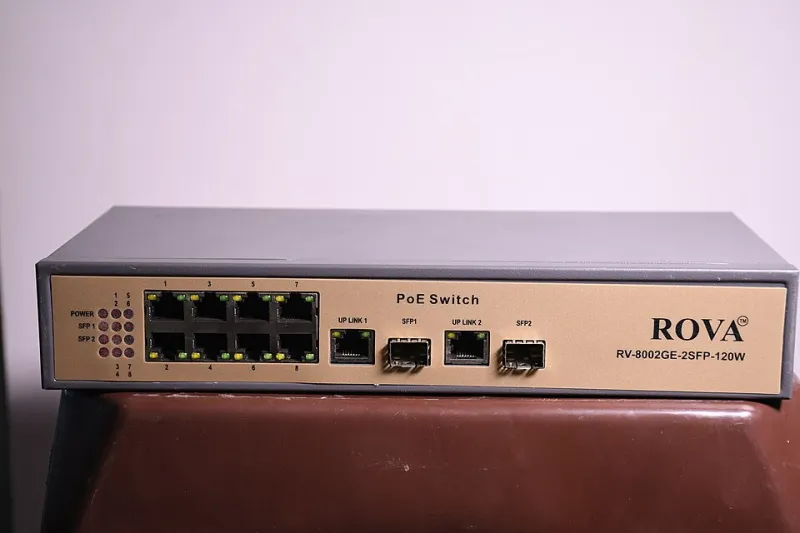
Unmanaged and Legacy Switches. In office environments, network switches distribute the broadband connection across multiple wired devices. An unmanaged switch purchased five or more years ago may be rated for Fast Ethernet (100Mbps) rather than Gigabit Ethernet. Every device connected through such a switch is immediately capped at 100Mbps, irrespective of the broadband connection's capacity. Even switches rated for Gigabit Ethernet can introduce performance limitations if they lack the processing capability to handle sustained high-throughput traffic across multiple ports simultaneously.
The Real Cost of the Mismatch
The financial dimension of this hardware gap is one that deserves explicit acknowledgement. A household paying £45 to £60 per month for a gigabit full-fibre service — and routinely experiencing 150 to 200Mbps due to internal hardware limitations — is effectively overpaying for the portion of that capacity they cannot access. Over twelve months, the premium paid for gigabit-tier service over a 500Mbps service may amount to £60 to £120, none of which delivers any practical benefit if internal hardware cannot utilise it.
For businesses, the calculation is more consequential. A professional services firm with ten staff members, each working on laptops equipped with Wi-Fi 5 adapters and routed through a legacy unmanaged switch, may be paying for a 900Mbps leased line whilst collectively experiencing throughput that a much less expensive service would have delivered with identical real-world results.
A Tiered Upgrade Guide for British Users
The good news is that addressing internal hardware bottlenecks does not require a comprehensive IT overhaul. The following tiered approach allows users to prioritise investment based on their circumstances and budget.
Tier One: Budget-Conscious Renters and Home Users (Under £150)
For individuals in rented accommodation who cannot modify fixed wiring infrastructure, the most impactful single investment is upgrading to a Wi-Fi 6 or Wi-Fi 6E router, assuming the broadband provider permits use of a third-party router. Wi-Fi 6 routers are available from reputable manufacturers at prices starting from approximately £60 to £90, and they deliver meaningful improvements in both throughput and multi-device performance over Wi-Fi 5 predecessors.
For desktop users with an older wired NIC, a PCIe Gigabit Ethernet adapter can be installed for under £25, immediately removing the 100Mbps ceiling that a Fast Ethernet card imposes. For those without PCIe slots — compact desktop users or those wishing to avoid internal modification — a USB 3.0 to Gigabit Ethernet adapter offers a functional alternative at a similar price point.
For laptop users whose device lacks Wi-Fi 6 capability, a USB Wi-Fi 6 adapter provides a straightforward upgrade path, typically priced between £30 and £55.
Tier Two: Home Office Users and Small Businesses (£150 to £500)
At this level, the priority is ensuring that both the wireless access point and the primary workstations are operating on current standards. A Wi-Fi 6 or Wi-Fi 6E mesh system — consisting of a primary router and one or two satellite nodes — provides consistent, high-throughput wireless coverage across larger premises, eliminating the dead zones and throughput degradation that single-router deployments suffer in multi-room environments. Quality mesh systems from established brands are available in the £150 to £300 range.
For wired connections in a multi-device office, replacing a Fast Ethernet unmanaged switch with a Gigabit Ethernet managed switch removes the 100Mbps per-port ceiling and introduces traffic management capabilities that improve overall network performance. Entry-level managed Gigabit switches suitable for small office deployments are available from approximately £80 to £150 for eight to sixteen port configurations.
Tier Three: Growing SMEs and Multi-Site Businesses (£500 and above)
For businesses with five or more users, a more structured network infrastructure investment is warranted. This tier encompasses enterprise-grade Wi-Fi 6E access points capable of supporting high device densities without throughput degradation, managed switches with Power over Ethernet (PoE) capability to simplify access point deployment, and network interface cards upgraded to 2.5 Gigabit Ethernet standard on key workstations — a specification increasingly available on mid-range motherboards and as affordable add-in cards.
At this scale, a network infrastructure audit conducted by a qualified IT professional is advisable before procurement. Identifying the specific bottlenecks within the existing estate ensures that expenditure is targeted at the components delivering the greatest performance improvement, rather than being distributed across wholesale replacement that may not be necessary.
Making the Upgrade Count
Britain's full-fibre infrastructure investment is, by any measure, a significant national undertaking. The connectivity it provides has the potential to transform productivity for businesses, enhance home working conditions, and support the digital services that households increasingly depend upon. Realising that potential, however, requires that internal hardware keeps pace with external infrastructure — and for a substantial proportion of UK users in 2025, it does not.
The investments required to close that gap are, in most cases, modest relative to the broadband subscription costs already being paid. Addressing the internal hardware bottleneck is not a luxury consideration; for those paying gigabit prices and receiving a fraction of that capacity, it is the only way to ensure that the broadband investment they are already making actually delivers what it promises.