Neural Network Demands: Evaluating Your Computing Arsenal for Britain's AI-Driven Future
The Hidden Infrastructure Behind AI Productivity
Artificial intelligence has transitioned from experimental technology to essential business tooling with remarkable speed. Microsoft Copilot, ChatGPT integrations, and localised language models now influence daily workflows across British enterprises. Yet beneath this software revolution lies a hardware reality that many organisations have yet to confront.
The computational demands of AI-enhanced applications differ fundamentally from traditional business software. Where conventional productivity tools require modest processing power, AI workloads stress system architectures in ways that expose the limitations of equipment that previously seemed adequate.
Decoding the Hardware Requirements Matrix
Modern AI applications leverage multiple processing pathways simultaneously, creating performance bottlenecks that vary depending on implementation approach. Cloud-based AI services like Microsoft Copilot primarily demand robust networking and sufficient RAM for data handling, whilst locally-deployed language models require substantial computational resources.
Neural Processing Units (NPUs) represent the newest addition to mainstream computing architectures. These specialised chips accelerate AI inference tasks, reducing processing time and power consumption compared to traditional CPU-based computation. However, NPU availability remains limited to the latest processor generations, creating a clear dividing line between AI-ready and AI-limited hardware.
Intel's latest Core Ultra processors and AMD's Ryzen AI series integrate NPUs capable of handling 10-45 TOPS (Trillion Operations Per Second), sufficient for lightweight AI tasks like real-time translation and basic content generation. More demanding applications require discrete graphics processing units with substantially higher computational throughput.
Memory Architecture: The Foundation of AI Performance
RAM requirements for AI-enhanced workflows have escalated dramatically compared to traditional business applications. Whilst 8GB sufficed for most office tasks, AI applications frequently demand 16GB as a baseline, with 32GB increasingly becoming the practical minimum for professional deployment.
The distinction becomes particularly apparent when running local language models. A 7-billion parameter model typically requires 14-16GB of available RAM, whilst larger 13-billion parameter variants demand 24-32GB. These requirements exist alongside the memory needs of the operating system and concurrent applications, often pushing total requirements beyond the capacity of standard business laptops.
Memory bandwidth also influences AI performance significantly. DDR5 RAM provides substantially higher throughput than DDR4, enabling faster data transfer between system components. For organisations planning AI deployment, memory architecture represents a critical consideration that extends beyond simple capacity metrics.
Graphics Processing: Beyond Gaming Applications
Graphics processing units have emerged as the workhorses of AI computation, offering parallel processing capabilities that align perfectly with neural network mathematics. However, not all GPUs deliver equivalent AI performance, and understanding the distinctions proves crucial for effective hardware selection.
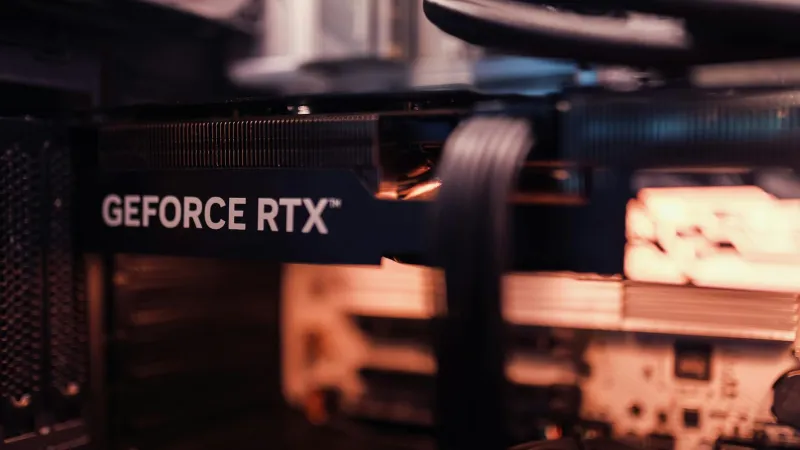
NVIDIA's RTX series graphics cards include dedicated AI acceleration hardware called Tensor cores, specifically designed for machine learning workloads. The RTX 4060 represents the entry point for serious AI acceleration, whilst RTX 4070 and above provide performance suitable for professional AI development and deployment.
AMD's RX 7000 series offers competitive AI performance at attractive price points, though software compatibility varies across different AI frameworks. For UK businesses evaluating graphics upgrades, NVIDIA's broader software ecosystem often justifies the premium, particularly for organisations planning extensive AI integration.
Storage Performance: The Overlooked Bottleneck
AI applications generate substantial data throughput that can overwhelm traditional storage systems. Language models, image processing tools, and data analysis applications frequently read and write large files, creating storage bottlenecks that limit overall system performance.
NVMe solid-state drives provide the minimum performance threshold for effective AI deployment, with PCIe 4.0 interfaces offering double the bandwidth of PCIe 3.0 implementations. For systems handling large datasets or multiple concurrent AI tasks, high-performance NVMe drives become essential rather than optional.
The storage requirements extend beyond raw performance to capacity considerations. AI model files, training datasets, and generated content can quickly consume hundreds of gigabytes, necessitating storage planning that accommodates growth rather than current needs alone.
Practical Assessment Framework for UK Organisations
Evaluating existing hardware for AI readiness requires systematic analysis across multiple performance vectors. Organisations can begin by inventorying current specifications against AI application requirements, identifying specific bottlenecks that limit performance.
Processor generation provides the initial filter, as NPU availability and instruction set optimisations vary significantly between CPU families. Systems more than three years old typically lack the architectural enhancements that enable efficient AI processing.
Memory assessment should consider both capacity and type, with DDR5 systems offering advantages for AI workloads. Graphics capabilities require evaluation based on intended AI applications, with discrete GPUs essential for local model deployment.
Strategic Upgrade Pathways
For organisations with compatible motherboards and power supplies, graphics card upgrades often provide the most cost-effective path to AI capability. Adding an RTX 4060 or equivalent can transform an otherwise capable system into an AI-ready workstation.
Memory upgrades represent another high-impact modification, particularly for systems with available DIMM slots. Increasing RAM from 16GB to 32GB frequently eliminates the memory bottlenecks that limit AI application performance.
Complete system replacement becomes necessary when fundamental architectural limitations prevent effective upgrades. Modern AI-optimised workstations integrate NPUs, high-bandwidth memory, and optimised cooling systems that older platforms cannot match.
The Investment Perspective
AI capability represents a strategic technology investment rather than an optional enhancement. Organisations that delay hardware modernisation risk being unable to leverage AI tools effectively, potentially falling behind competitors who invest proactively in appropriate infrastructure.
The cost of AI-ready hardware continues declining as manufacturers increase production volumes and competition intensifies. For UK businesses, the question is not whether to upgrade, but when to implement changes that enable full AI capability realisation.